Monday, September 19, 2016

Tom Thomson - Suicide? History of a flawed idea.

As I explore in The Many Deaths of Tom Thomson: Separating Fact from Fiction, three causes of death have been considered since Tom Thomson was found dead in July 1917: accidental drowning, murder, and suicide. His death was ruled as accidental at the time, but the possibility that he had been murdered was given some consideration. Suicide, however, did not appear as a believable option in discussions of the case until the 1970s.

The possibility that Thomson might have committed suicide was first raised in the fall of 1917. The only accounts are second-hand, though. In December 1917, two Thomson family members reported being told that stories of Tom having died by his own hand were circulating in Canoe Lake. The family likely learned of the gossip from one of Tom’s friends who had visited Canoe Lake in September to help build a cairn memorializing his friend. Thomson family members were angry and frustrated that such a damaging and groundless theory was being spoken of, and sought to have the rumours quashed.

Their efforts may have been successful, or perhaps the gossip was implausible enough that the idea gained little traction beyond a few residents of Canoe Lake. Whatever the reason, it was not until the 1970s that suicide reappears as a possible explanation for Thomson’s death. In 1972, Charles Plewman, a man who during the summer of 1917 had visited Canoe Lake occasionally, raised the prospect of suicide. He offered his memories in an article publishedby the Canadian Camping Association magazine. Plewman stated that he had been told by Shannon Fraser, operator of the lodge Thomson had been living in at Canoe Lake, that Thomson’s reason for suicide was that he was being pressured to marry a local woman. Thomson, apparently uninterested in marriage, could not conceive of how to escape the situation with honour except by killing himself.

Five years later, in 1977, Roy MacGregor added fuel to Plewman’s suggestion that Thomson might have committed suicide. MacGregor offered that Thomson’s girlfriend may have been pressuring him to marry because she was pregnant. He concluded this situation on the basis that the Huntsville newspaper noted in fall 1917 that the woman was leaving for an extended trip to the United States.

Over the last decade or so, an emerging line of thinking proposes that Thomson suffered from some kind of psychiatric or neurological illness, such as bipolar disorder or autism. These theories are provocative, but ultimately frustrating in that they cannot be authoritatively proven or disproven. They also don't answer the question of whether Thomson actually committed suicide.

Much of the suicide theory is based on such flimsy hearsay evidence that can simply be dismissed as groundless gossip. 

If Thomson was suicidal over his relations with a woman, there is much that remains to be proven. No documentation exists of letters between Thomson and the woman. No documents have been produced from before Thomson’s death where either Thomson or the woman in question even refer to each other! 

Charles Plewman waited more than fifty years to tell the story he said Fraser had told him. The delay should encourage scepticism. MacGregor surmises that because the woman left on a trip to the U.S. in the fall of 1917 that she might be pregnant. He does not explain, however, why the family would advertise her trip in the newspaper if she was leaving the community to have a child secretly. 

As I propose in The Many Deaths of Tom Thomson, one critical concern that none of the suicide theories adequately answer (aside, of course, from the general lack of solid evidence) is regardless of all of the convoluted efforts to create a suicide motive for Thomson, why – in an environment with easy access to guns, axes, hunting knives, speeding trains, waterfalls, fires, rope, etc – the man might try to end his own life by rowing out into a relatively well-travelled lake in the middle of a Sunday and throwing himself overboard. 

---

All of the links for this post direct back to excerpts of transcribed historical documents provided on the website Death On A Painted Lake: The Tom Thomson Tragedy. Gregory Klages was Research Director for the site, launched by the Great Unsolved Mysteries in Canadian History project in 2008. Klages is the author of the 2016 book, The Many Deaths of Tom Thomson: Separating Fact from Fiction (Dundurn Press).


Friday, August 26, 2016

Writer Mark Reynolds reviews "Many Deaths…" for Christopher Moore's blog

Mark Reynolds, a Chicago writer who has written for popular outlets such as Canada's History, recently reviewed The Many Deaths of Tom Thomson for Christopher Moore's blog.

Reynolds says:
"Klages' mission was to rip up th[e] overgrowth of supposition away from the record, and then trace the vines and roots of each to disentangle them from the truth. As such, reading the book is less like reading a conventional history that it is akin to sitting in the jury while a very thorough prosecutor methodically, rigorously and uncompromisingly builds a case. No witness, no piece of evidence is left without having its credibility or provenance examined to the minutest degree."

Regarding Klages' assessment of one popular writer's work on Thomson, Reynolds offers:
"...the ruthlessness with which Klages reveals the speculation, sloppy research and unsupported family legend through which the author has polluted the public understanding of Thomson’s story was a tour de force of rigorous history over sensationalizing careerism." 

Wednesday, August 17, 2016

Award-winning author Debra Komar reviews MDTT on Goodreads

Debra Komar, author of the multiple award-winning 'The Bastard of Fort Stikine' (among other titles), has reviewed The Many Deaths of Tom Thomson on Goodreads. I am flattered that such a respected author (and retired forensic pathologist) had so many good things to say about the book, including:

"I have read many books on the subject and this is the most even-handed account available. Klages ...does a great job of tracing the origins of the narratives [regarding Thomson] that persist in Canadian history. The book is better written than any of its predecessors and is competently researched. ...the book is interesting, surprisingly fast-paced and lean, and worth a read."


Update: pictures from summer 2016 'Many Deaths of Tom Thomson' author talks

Scugog Shores, May 2016:


Lakefield Literary Festival, July 2016:


Monday, August 8, 2016

Interview: CBC Radio's "Fresh Air" re: Many Deaths of Tom Thomson

In July, Sean Foley, interim host of CBC Radio's "Fresh Air", interviewed Gregory Klages regarding The Many Deaths of Tom Thomson, reflecting on the significance of Thomson's life and art, sense-making about Thomson's death, and what Canoe Lake feels like today.

Thursday, July 7, 2016

Tom Thomson: Murdered? History of a flawed idea.

The possibility that Tom Thomson had been murdered was first raised in July 1917, before Thomson’s death was even confirmed. Newspaper coverage speculated that murder was among the possible reasons for Thomson’s disappearance.

In July 1917, Dr. G. Howland, who was holidaying in Algonquin Park and who was called upon to examine Thomson's remains, concluded that Thomson died by drowning. At the time, neither he, Park Ranger Mark Robinson (who supervised the search for Thomson), the coroner, nor the Park Superintendant recorded any suggestions that Thomson's death had been anything other than an accident (no one else recorded them making such suggestions either).

Going public with suspicions

The first investigator to publicly claim that Thomson had suffered fatal violence was Blodwen Davies. In summer 1931, she asked Ontario’s Attorney General to excavate Thomson’s original Algonquin Park burial place, on the grounds that the coroner’s conclusion of ‘accidental drowning’ was wrong. Davies argued that evidence taken in 1917 clearly pointed to Thomson having sustained a fatal blow to his head. She repeated this claim in her self-published book, A Study of Tom Thomson, the second she devoted to Thomson.

In the 1950s, a conversation with a group of people (likely at Canoe Lake) was recorded on audio tape. During this conversation, Mark Robinson offered that Tom Thomson's temple clearly showed signs of violence. This is the first record we have of Robinson offering such an assertion. He does not make similar statements in his testimony from 1917, or during the 1930s.

A conspiracy theory re-emerges

The murder theory really blossomed as an explanation during the late 1960s. A 1969 CBC documentary and a 1970 book suggested that Thomson had been killed. While the documentary - Was Tom Thomson Murdered? - is pretty much forgotten today, the book – William Little’s The Tom Thomson Mystery – provided many of the claims upon which proponents of the murder theory continue to build their case.

Acrobatic adaptations

The contemporary writer who stands at the forefront of proposals that Thomson was murdered is Roy MacGregor. MacGregor is Canada’s most prolific author regarding the case, having produced magazine articles, a fiction book (published twice, under different titles), and most recently, a non-fiction book devoted to Thomson’s death.

During the late 1970s, MacGregor suggested that Thomson might have been killed in a fight on the night of Saturday, July 7. This is an interesting theory, but evidence points to several people, Mark Robinson included, having seen Thomson on the following morning, July 8. 

In his 2010 book, MacGregor adjusted his argument that Thomson was murdered to fit with the evidence that Thomson was seen on the morning of Sunday, July 8. In his revised theory, MacGregor suggested that Thomson might have returned to Canoe Lake, seen by few, on the night of Sunday, July 8. Upon his return, according to MacGregor, Thomson was killed. This proposal leaves unanswered how Thomson's canoe would be seen floating, overturned, on the afternoon of July 8, hours before MacGregor suggests Thomson was killed.


The Many Deaths of Tom Thomson - The 'Mystery' Resolved?

In The Many Deaths of Tom Thomson, I subject Davies', Little's and MacGregor's claims (as well as those of others who have written about the case) to rigourous analysis. As they all argue that Tom Thomson could very well have been murdered, the strength of their arguments is critical to evaluating the case.

---

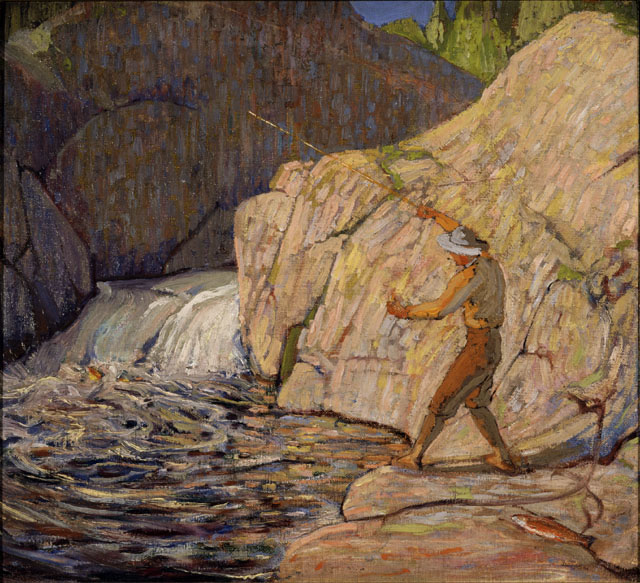
Image: Tom Thomson. c. 1916. The Fisherman. Oil on canvas. Collection: Art Gallery of Alberta.

All of the links for this post direct back to excerpts of transcribed historical documents provided on the website Death On A Painted Lake: The Tom Thomson Tragedy. Gregory Klages was Research Director for the site, launched by the Great Unsolved Mysteries in Canadian History project in 2008. Klages is the author of the 2016 book, The Many Deaths of Tom Thomson: Separating Fact from Fiction (Dundurn Press).