Showing posts with label Murder. Show all posts

Friday, February 23, 2018

Tom Thomson Death Myth #6 - 'Tom Thomson: killed by a German sympathizer'


One of the more fantastical rumours regarding Tom Thomson’s death is that he was killed in a fight over the war that had been raging in Europe. These stories hinge on the idea that Tom Thomson, lover of nature, nationalist, & good-humoured prankster – the model Canadian man – was killed by a rude German-American who sympathized with the ‘Huns’. Smacking of period propaganda and stereotypes, these stories wildly misrepresent the facts.

In 1917, no one suggested that a foreigner murdered Tom Thomson, or even that he had gotten in a fight over the war.

So where does this story originate?

The closest contemporary (1917) documents come to suggesting a German sympathizer was skulking around Canoe Lake is a notation in the daily diary of Mark Robinson. In May 1917, Robinson wrote, “I am of the opinion that [Martin Blecher Jr. ] is a German spy.” Robinson, it might be recalled, was the Algonquin Park Ranger responsible for the Canoe Lake area where Thomson was staying in the spring and summer of 1917.

What were Blecher’s ties to Germany?
Before looking at some facts of Blecher’s life, it might be useful to contextualize Robinson’s comment. From November 1915 through March 1917, he had been serving with the Canadian Expeditionary Force. Robinson had only returned to duties as a Park Ranger in April 1917, a few weeks before writing his comment about Blecher Jr., and three months after having returned from European military service.

What can we make of Robinson’s suspicions? As Mary Garland has established, Martin Blecher Jr.’s closest tie to Germany was through his German-born grandfather, Henry Blecher, who died thirty years before Martin was born. Martin Jr. was born a US citizen, as was his father. Both were life-long residents of Buffalo, New York. Nonetheless, Mark Robinson’s identification of Blecher with Germany would persist. In 1930, he would describe Blecher Jr. as an “American German tourist.”

Where did this sentiment come from? In 1910, Robinson had asked Blecher Jr.’s father to stop flying the US flag on his Canoe Lake cottage, a request with which the man complied. Could this have planted a seed of hostility towards the Blecher family? Alternatively, Robinson may have overheard Blecher suggesting the Germans could win the war and interpreted this as sympathy for the German side. We will likely never know what prompted Robinson’s perceptions.

Was Blecher a ‘draft dodger’?
Regardless, Robinson’s persistent biases would later affect how those interested in the Thomson case made sense of things. In 1931, after corresponding with Robinson, Thomson biographer Blodwen Davies would intimate that Blecher Jr. was hiding in Canada to avoid being drafted for the US Army. She reported a rumour she heard at Canoe Lake that a representative of the US War Department had actually visited the area to summon Blecher back to the United States!

The rumour does not make much sense once we know the history of how Blecher was drafted. Blecher Jr. registered for the United States draft in November 1917, seven months after the US entered the war (and four months after Thomson’s death). He was not called to service until August 1918. In 1931, the US War Department would outline Blecher’s draft record to Davies, indicating that it was correct that he did not report for the draft when called, but that upon investigation (during the winter of 1917/18) his lack of appearance was deemed ‘nonwilful’.

Despite the assurances of the US War Department to Davies, the rumour that Blecher was a draft dodger (and a German) would continue to circulate, being repeated decades later by commentators such as William Little, and Roy MacGregor, as well as ‘eyewitness’ Daphne Crombie.
 
Did Tom and Blecher get in a fight?
Davies certainly believed that Thomson had been in a significant fight before his death, and intimated that Blecher was involved. In her 1931 letter to the Ontario Attorney General, Davies reported that Thomson had gotten in a fight with an American tourist. Around this time, she likely inquired whether Tom’s brother, George, had heard anything about a fight when he had been Canoe Lake during July 1917. George responded that he had heard that “there was some ill feeling between Tom and some man in that region”, but offered no more details. George suggested that he had perhaps heard the story from one of the Rangers, but “I didn’t at the time attach any serious importance to the report.”

Decades later, it was suggested that Blecher and Thomson might have fought not because Blecher was a draft dodger, but because Thomson suggested he was a coward. In 1970, Dr. Noble Sharpe would suggest that Tom had gotten in a fight after having “accused the other man of being a deserter from the American Army."

Also in 1970, William Little added to the groundless claims about a fight between Blecher and Thomson. In The Tom Thomson Mystery, Little concocted a conversation between the men, writing that an angry exchange between the two men concluded with Blecher exclaiming, “Stay out of my way if you know what’s good for you.” This was the first time anyone had much such a blatant claim, let alone provided the dialogue that took place between the two men. Nonetheless, Little’s almost surely fictionalized account has since often been repeated as if it must be fact.

Conclusion:
Suspicions about Martin Blecher Jr. are built upon misrepresentation and errors. In 2010’s Northern Light, Roy MacGregor stated that “almost all versions of the Tom Thomson story” include the fight. While this is not entirely true, the story has often been repeated since publication Little’s book. Perhaps most importantly, Roy MacGregor certainly gave the Little account credence. In 1973, he would repeat the comments Little likely imagined Blecher having said. He would repeat the doubtworthy statements in his 2010 book (although he did not use them to argue that Blecher killed Thomson).

These suspicions regarding Martin Blecher Jr.’s involvement in Tom Thomson’s death may have been, as Webb has suggested, a product of wartime anti-German sensibilities, as well as later anti-American sentiments. Aside from errors, gossip and groundless impressions, though, no evidence indicates Thomson and Blecher had anything other than occasional neighbourly interactions. Nonetheless, through repetition, flawed speculation about Martin Blecher Jr. has helped to give the false impression that the man is a viable suspect in the stories that Tom Thomson was murdered.


Gregory Klages - © 2018
---
Gregory Klages was Research Director for the website Death On A Painted Lake: The Tom Thomson Tragedy, launched by the Great Unsolved Mysteries in Canadian History project in 2008. Klages is the author of the 2016 book, The Many Deaths of Tom Thomson: Separating Fact from Fiction (Dundurn Press).

Friday, September 29, 2017

Tom Thomson death myth #9 - 'Tom died over a debt'


Tom Thomson’s July 1917 death shocked his friends and family. Given that the man was only 39 years old, many found his death hard to explain. Those who examined Thomson’s corpse concluded that he drowned by accident. Nonetheless, gossip and suggestions of alternate explanations have fuelled a century of speculation.

In the 1970s, it was proposed that Tom Thomson died in a fight over a debt. The story - dependent on gossip and demonstrable errors - is wrong.

The story that Tom Thomson died over repayment of a debt can be tied to two persons. The first is Daphne Crombie, a woman who met Tom Thomson at Canoe Lake in 1917. The second is Roy MacGregor, a journalist and author who since the early 1970s has published a multitude of articles and two books regarding Thomson's death (one fiction and one non-fiction).

Although the roots of the debt story can be found in evidence recorded in 1917, the idea that Thomson was killed over a debt first appeared in 1977 (sixty years after Thomson’s death!). That year, Roy MacGregor wrote 'The Legend', an article in The Canadian magazine. In the article, MacGregor shared comments he claimed to have been told by Crombie.

In MacGregor's account, Crombie had speculated that Tom might have been killed by Shannon Fraser in a fight over money. (Fraser operated Mowat Lodge in Algonquin Park, where Thomson had been living since early April 1917.) Crombie apparently offered that Thomson had loaned Fraser money, and in July 1917, asked him to repay the debt. A fistfight ensued. During its course, Thomson fell, striking his head on the fire grate. The blow either killed Thomson immediately, or left him unconscious. Regardless, Crombie speculated, Fraser, assisted by his wife Annie, and out of fear of being charged with murder, hid the body in the lake.

In his 2010 book, Northern Light, MacGregor added to the story, stating that Winnie Trainor had told Margaret Thomson (Tom’s sister) that, “a $250 loan Tom had made to Fraser two years earlier had not yet been fully paid back.” *
An unpaid debt, a fight, murder, and a hidden corpse... compelling anecdotes that make a tantalizing story. The story, as told in MacGregor’s 1977 and 2010 accounts, directly contradicts the evidence from 1917.

After Thomson’s death, several members of Tom’s family were in contact with Winnifred Trainor, a Huntsville woman whose family leased a cottage at Canoe Lake. In late August or early September 1917, Trainor met one of Tom’s sisters, Margaret Thomson, in Toronto. They discussed Tom’s life, and of course, his death. In early September 1917, Margaret wrote Tom’s patron, Dr. James MacCallum, sharing with him what she had learned from Trainor.

By the time the two women met, Margaret was aware that Tom had loaned Shannon Fraser $250 to buy canoes. She inquired with Trainor about the loan. Trainor told Margaret that, “she had asked Tom this spring if he ever got that money, and he said he got it all but in very small amounts.” **

Tom Harkness, Tom Thomson’s brother-in-law and executor of Tom’s estate, pursued the issue with Fraser in September 1917, asking, “did you pay Tom for the canoes he bought for you and when.” [sic]

The same month, Winnie reported to Tom's brother, George, what she had told Margaret, stating, “Tom said this spring while at our house that he had loaned Fraser $250.00 for canoes, but that he had got it all back but in little bits though.”

Trainor’s reports that the debt had been repaid seems to have satisfied Harkness, who did not pursue the issue of the 'canoe debt' any further.

Following on Trainor's two statements that Fraser's debt to Tom had been repaid, no one closely involved in Tom's life suggested that Fraser owed Tom an outstanding debt. None suggested Fraser and Thomson had a fight over money. None suggested Tom had died seeking repayment of the debt.

MacGregor's statement that Trainor claimed the debt had not been repaid - is simply wrong. Trainor’s letter clearly indicates the debt was repaid. (See Notes below.)

It would be easy for us to hold MacGregor culpable for his 1977 error. This is not an entirely fair assessment, though. While he reported Crombie’s claim, we know her speculation is contradicted by Trainor’s 1917 claims. In 1977, however, Trainor’s letter was still held privately by the Thomson family. It was not made publicly accessible until the 1990s, when it was donated to Library & Archives Canada. In 2008, 'Death On A Painted Lake: The Tom Thomson Tragedy' project made excerpts from the letter available freely on the world wide web. 

Writers who have retold and expanded on Crombie/MacGregor’s ‘debt story’ since the 1990s – including MacGregor - have overlooked or ignored Trainor’s 1917 statements that the debt was repaid, and perpetuated a flimsy myth about Tom Thomson’s death.

(For instance, in 2018, John Little claimed in Who Killed Tom Thomson? that, “[Fraser] had evidently paid a good portion of the loan back, but there was still some money owed.”)


------
NOTES:
* MacGregor's statement can be found in Chapter 9 of Northern Light: The Story of Tom Thomson and The Woman Who Loved Him. For more, see the note below. Once again, he writes: "a $250 loan Tom had made to Fraser two years earlier had not yet been fully paid back.”

** The quoted passage from Margaret Thomson's 9 Sept. 1917 letter directly contradicts MacGregor's 2010 account of what the letter says. Once again, she writes, "[Trainor] had asked Tom this spring if he ever got that money, and he said he got it all but in very small amounts.”


Gregory Klages - © 2017
---
Gregory Klages was Research Director for the website Death On A Painted Lake: The Tom Thomson Tragedy, launched by the Great Unsolved Mysteries in Canadian History project in 2008. Klages is the author of the 2016 book, The Many Deaths of Tom Thomson: Separating Fact from Fiction (Dundurn Press).

Tuesday, September 19, 2017

Tom Thomson death myth #10 - "Fishing line = murder."

A popular story relates that Tom Thomson’s body was found with fishing line wound around one ankle. A popular interpretation is that the line proves someone tried to hide Thomson’s corpse by tying a weight to his body before sinking the body in the lake.  

The fishing line story (and the conspiracy theory spun from it) is not supported by the evidence we have available about Thomson's corpse.

When Tom Thomson’s body was discovered in July 1917, two men examined his remains: a doctor holidaying in Algonquin Park, and an Algonquin Park Ranger. At the time, neither man recorded seeing fishing line around any part of Thomson’s body. The claim that fishing line was found on Thomson's body was first made in the 1930s - thirteen years after Thomson's death - by Park Ranger, Mark Robinson. Robinson's claim was never corroborated by any other witnesses, though. Robinson also never explained why his 1917 notes don't mention the fishing line. Complicating his claim further, in the 1950s, Robinson offered yet another version of his testimony: he claimed he had noted the fishing line in 1917 (which we know is false), reported different 'facts' about the fishing line than he had in the 1930s, and stated his conclusion about Thomson’s cause of death that was different from what he stated in 1917 or 1930.

All of these facts strongly suggest the ‘fishing line story’ is suspect, and raises the prospect that one of the pillars supporting murder theories is weak.

---

We know that Tom Thomson’s body was discovered on the morning of July 16, 1917.

We know this from several documents produced that day, and in the days that immediately followed. The daily diary of Mark Robinson, the local Algonquin Park Ranger, is one of the key records we have from July 1917 (worth noting: his diary is the only record Robinson produced in 1917). In his diary, Robinson recorded the search for Thomson, as well as discovery and displacement of Thomson's remains.

For the July 16 entry, Robinson states that Thomson’s body was discovered floating in Algonquin Park's Canoe Lake about 9 a.m. He writes that George Rowe and ‘Lowrie’ Dixon, “took same and brought it to shore.”

The following day, Robinson records that Thomson’s body was removed from the lake. He and Dr. G. Howland, who was holidaying at Canoe Lake, examined the corpse. Later that day, Robinson recorded observations about Thomson’s remains. Nowhere in these notes – nor anywhere else in his 1917 diary entries – is there mention that he found a fishing line around any part of Thomson’s corpse.

A transcription of Howland’s 1917 notes, provided to researcher Blodwen Davies by the Nipissing Crown Attorney’s office in the 1930s, doesn’t include any mention of suspicious fishing line on Thomson’s remains either. Similarly, a transcription of Howland’s observations held by George Thomson – Tom’s brother – also supplied to Davies in the 1930s, doesn’t mention fishing line.

That no 1917 account makes any mention of suspicious fishing line is important. Clearly, in 1917, either no fishing line was observed, or if it was observed, it was not regarded as in any way important to Thomson’s disappearance and death.

If the fishing line wasn’t noted in 1917, we can learn much about the claim by tracking when it first appeared, and how the story evolved.

Only one person - Mark Robinson - ever claimed that fishing line was found on Tom Thomson's corpse. Robinson mentioned the line for the first time in a 1930 letter to Blodwen Davies, thirteen years after Thomson’s death. At this time, Robinson suggested the line was not Thomson’s regular fishing line.

Why Robinson would wait thirteen years to offer this insight, particularly if he felt it provided evidence that Thomson might have died by foul play, is difficult to understand. Making Robinson’s testimony even more suspect, in the early 1950s, he added details to his story about the fishing line. Robinson stated that when he examined Thomson’s corpse, he found the line was “carefully” wound “16 or 17 times” around Thomson’s ankle. Robinson noted that he could prove this claim because he recorded his observations in his diary. We know, however, that his diary says nothing of the sort; it doesn’t mention fishing line at all!

Robinson’s ‘fishing line’ stories from the 1930s and 1950s do not agree with any 1917 evidence (even evidence recorded by Robinson himself in 1917). This should raise our suspicions about the tale. That Robinson’s accounts gained new elements and more details over decades also suggests skepticism about Robinson's claims 
– particularly those furthest from the experiences he describes - is necessary.

So, is the fishing line story purely fiction? Did Robinson invent it out of thin air? What if the fishing line existed, but has an innocent explanation?


Robinson was not present when Thomson’s body was discovered, or when it was brought to shore. His diary doesn’t mention how the guides brought Thomson’s body to shore, or to anchor the body once it was brought to shore. If the guides used fishing line to tow or anchor the body, as time passed Robinson might have forgotten this entirely logical explanation. If this is the case, however, it does not explain why Robinson would not have asked questions about it in 1917. The record he produced at the time Thomson’s body was discovered suggests that Robinson’s suspicions were not raised, either because the fishing line had a reasonable explanation, or because he never saw it all.

Gregory Klages - © 2017


---
Perplexed? Challenged? Interested in reading more?

To read more evidence about Tom Thomson's death, and to learn how story-telling about Thomson's death has diverged further and further from the evidence, read The Many Deaths of Tom Thomson: Separating Fact from Fiction (Dundurn Press, 2016). 

Gregory Klages was Research Director for Death On A Painted Lake: The Tom Thomson Tragedy, part of the international award-winning Great Unsolved Mysteries in Canadian History project. 

Tuesday, June 13, 2017

Mark Robinson's influential, but inconsistent, testimony about Tom Thomson

Over a period of almost four decades, Mark Robinson, the Algonquin Park Ranger who in July 1917 organized the search for missing artist Tom Thomson, produced multiple remembrances: anecdotes about the artist, accounts of Thomson’s last days, and descriptions of the days following discovery of Thomson’s corpse.

Robinson’s testimony - without much distinction being made between the various accounts provided over thirty-five years -  has often been portrayed as the definitive, authoritative account of the conditions surrounding Thomson’s death. While it is true that Robinson’s 1917 testimony regarding what happened to Tom Thomson must be considered – his daily diary is one of the few ‘on the scene’ accounts we have - inconsistencies and contradictions between Robinson’s 1917 account and his later accounts requires that all of his testimony should be approached with skepticism.  

What was Mark Robinson’s involvement in this case?
Mark Robinson. Undated. Algonquin Park Museum & Archives.
APMA 184

Mark Robinson first served as an Algonquin Park Ranger from 1909 through to 1915.

Robinson met Tom Thomson in 1912. His daily diaries for 1912, 1913 and 1915 include brief references to Thomson as one of many people moving through the park.

In fall 1915, Robinson took up service with the Canadian military, serving in Canada and Europe until the winter of 1916/17.

In April 1917, Robinson returned to service at Algonquin Park’s Joe Lake Station, within easy walking distance of Canoe Lake’s Mowat Lodge. As the presiding park authority for the area, when Tom Thomson went missing in July 1917, Robinson organized the search. He also attended the examination of Thomson’s corpse conducted by Dr. G. W. Howland on July 19, 1917.

Robinson would serve as a park Ranger into the early 1940s, and passed away in 1955.

What accounts did Mark Robinson produce?
We have, essentially, three accounts from Robinson.

One body of testimony was produced in July 1917. Robinson maintained a daily diary, in which he recorded observations about park life, including lists of tasks he completed each day, the conditions of animals and plants, and notes about who was moving through the park (along with where they were from and what their activities in the park would be). He also sometimes noted his own feelings or rumours, such as his comment in April 1917 that he believed Martin Blecher Jr. was a "German spy."

A second body of testimony is a series of letters Robinson exchanged with Tom Thomson biographer Blodwen Davies in 1930 and 1931. Davies had published a Thomson biography in 1930, and had sought out many of Thomson’s acquaintances, Robinson among them. Through his letters, Robinson provided anecdotes about Thomson’s art, his attitude toward nature, remembrances about the search for Thomson, and suggestions about who else might offer useful information.

A third body of testimony is an audio recording of Robinson, likely produced in 1953 by Taylor Statten at Canoe Lake (an Alex Edmison transcription is held by the National Gallery of Canada). The recording preserves Robinson’s story-telling about Thomson, including his ideas about Thomson’s disappearance and death. He was clearly relating his tales to a small audience, who can be heard applauding at the end of the recording.

What is it about Robinson’s testimony that isn’t trustworthy?
A regrettable tendency among commentators addressing Thomson’s death is to approach Robinson’s three bodies of testimony as consistent when they are not. The evolution in Robinson’s accounts and claims is critical to explain if we are to make sense of what Robinson contributes to our understanding of Thomson’s death.

For instance, let’s consider two critical examples of how key aspects of Robinson’s testimony changed from 1917 through to the 1950s.


EXAMPLE 1:
Robinson's testimony about Thomson's injuries, and the conclusions these injuries suggesting about Thomson's cause of death, changed over decades.

In his 1917 daily diary, Robinson noted a bruise on Thomson’s temple, which he suggested was “evidently caused by falling on a rock.” He also states, “otherwise no marks of violence on body.”

In the 1930s, he backed away from his suggestion of accidental death, stating, “Tom was said to have been drowned. It may be quite true but the mystery remains.” While he perhaps speculated that Thomson suffered foul play, we don’t have any written records confirming this suspicion.

The first written record we have where Robinson suggests Thomson was murdered was produced in the 1950s. It was then that Robinson introduced the suggestion that Thomson’s temple “looked as if he had been struck – struck with the edge of a paddle.” 

Robinson’s inconsistent testimony about the condition of Thomson's corpse, and Robinson's conclusions regarding the condition of the remains, has provided much of the impetus for murder conspiracy theories.


EXAMPLE 2: 
Related to the 'murder' story, those who suggest Tom Thomson was found with fishing line around his leg owe this claim to a selective reading of Mark Robinson’s changing testimony. 

In 1917, Robinson makes no mention of a fishing line around any part of Thomson’s corpse in the notes he made after inspecting Thomson’s remains. (In fact, no 1917 account makes mention of fishing line found on Thomson’s corpse.)

This is important, because the first mention of the fishing line that we have comes from Mark Robinson. In 1930, almost fifteen years after Thomson’s death, Robinson mentioned the line for the first time to Thomson biographer, Blodwen Davies. At this time, Robinson suggested the line was not Thomson’s regular line.

Making Robinson’s testimony even more suspect, in the early 1950s, Robinson added details to his story about the fishing line, stating that it was “carefully” wound “16 or 17 times” around Thomson’s ankle.

That the two later accounts did not agree with any 1917 evidence (even evidence provided by Robinson himself) should raise suspicions. That over 35 years Robinson introduced new details into his accounts, and that contrary to how human memory works the accounts became more detailed, also suggests skepticism about Robinson’s claims is necessary.


What can we conclude? 
In his 1917 account, Mark Robinson does not indicate that he suspected that Thomson’s death was anything but accidental. Even his circumstantial testimony records no features pointing to Thomson having suffered foul play or committing suicide. Robinson certainly did not record that he raised any concerns with the coroner or park superintendent.

Thirteen years later, his accounts had evolved. While he does not challenge the conclusion that Thomson died by accident, he intimates that something about the story is not fully known.

By the early 1950s, his claims and conclusions had changed yet again. In the 1950s, he suggested that Thomson had clearly been murdered. Frustratingly, he doesn't provide any explanation why he offered no indication of this belief in 1917 or during the 1930s, or evidence to support such an interpretation.

We do know that working as the Canoe Lake park ranger for decades after Thomson’s death, Robinson was called upon to share his memories many, many times. Over decades, with retelling upon retelling of his stories, perhaps Robinson’s memories become fuzzy, perhaps he even confused memories with fanciful recollections.

For those who suggest that this suggestion unfairly besmirches Robinson’s reputation, we do have some evidence that he misrepresented facts. In the 1950s, he supports his claim regarding the number of times fishing line was wound around Thomson’s ankle with the statement, “I know this because I have it written down in my diary.” Robinson was fortunate that none of his friends were curious enough to ask Robinson to prove this. Why? As I mentioned above, Robinson’s daily diary includes no mention of fishing line at all. His 1950s statement - whether by error or lie - is simply wrong about a critical fact.

But, surely, some claim, couldn’t Robinson simply have remembered more about the story than he did in 1917? This is possible. Over time he may also have made different sense of what he remembered.

I believe we can explain some of the evolution in Robinson’s testimony by looking at the evidence. For instance, if Robinson’s memory about fishing line is correct, there is a far more simple, straight-forward explanation for it being found around Thomson’s ankle than an attempt to hide a corpse. For more on this topic, see Chapter 10 of The Many Deaths of Tom Thomson.

Whatever the explanation, the inconsistencies in Robinson’s accounts regarding Tom Thomson’s death strongly suggest that all of Robinson’s testimony merits careful consideration. The ‘facts’ he remembers don’t always line up with contemporary accounts produced by others, and just as importantly, Robinson’s accounts produced over 35 years aren’t always consistent with each other. In this regard, the authority of any of Robinson’s accounts about the life and death of Tom Thomson is questionable.


---

All of the links for this post direct back to excerpts of transcribed historical documents provided on the website Death On A Painted Lake: The Tom Thomson Tragedy. Gregory Klages was Research Director for the site, launched by the Great Unsolved Mysteries in Canadian History project in 2008. Klages is the author of the 2016 book, The Many Deaths of Tom Thomson: Separating Fact from Fiction (Dundurn Press).


Thursday, July 7, 2016

Tom Thomson: Murdered? History of a flawed idea.

The possibility that Tom Thomson had been murdered was first raised in July 1917, before Thomson’s death was even confirmed. Newspaper coverage speculated that murder was among the possible reasons for Thomson’s disappearance.

In July 1917, Dr. G. Howland, who was holidaying in Algonquin Park and who was called upon to examine Thomson's remains, concluded that Thomson died by drowning. At the time, neither he, Park Ranger Mark Robinson (who supervised the search for Thomson), the coroner, nor the Park Superintendant recorded any suggestions that Thomson's death had been anything other than an accident (no one else recorded them making such suggestions either).

Going public with suspicions

The first investigator to publicly claim that Thomson had suffered fatal violence was Blodwen Davies. In summer 1931, she asked Ontario’s Attorney General to excavate Thomson’s original Algonquin Park burial place, on the grounds that the coroner’s conclusion of ‘accidental drowning’ was wrong. Davies argued that evidence taken in 1917 clearly pointed to Thomson having sustained a fatal blow to his head. She repeated this claim in her self-published book, A Study of Tom Thomson, the second she devoted to Thomson.

In the 1950s, a conversation with a group of people (likely at Canoe Lake) was recorded on audio tape. During this conversation, Mark Robinson offered that Tom Thomson's temple clearly showed signs of violence. This is the first record we have of Robinson offering such an assertion. He does not make similar statements in his testimony from 1917, or during the 1930s.

A conspiracy theory re-emerges

The murder theory really blossomed as an explanation during the late 1960s. A 1969 CBC documentary and a 1970 book suggested that Thomson had been killed. While the documentary - Was Tom Thomson Murdered? - is pretty much forgotten today, the book – William Little’s The Tom Thomson Mystery – provided many of the claims upon which proponents of the murder theory continue to build their case.

Acrobatic adaptations

The contemporary writer who stands at the forefront of proposals that Thomson was murdered is Roy MacGregor. MacGregor is Canada’s most prolific author regarding the case, having produced magazine articles, a fiction book (published twice, under different titles), and most recently, a non-fiction book devoted to Thomson’s death.

During the late 1970s, MacGregor suggested that Thomson might have been killed in a fight on the night of Saturday, July 7. This is an interesting theory, but evidence points to several people, Mark Robinson included, having seen Thomson on the following morning, July 8. 

In his 2010 book, MacGregor adjusted his argument that Thomson was murdered to fit with the evidence that Thomson was seen on the morning of Sunday, July 8. In his revised theory, MacGregor suggested that Thomson might have returned to Canoe Lake, seen by few, on the night of Sunday, July 8. Upon his return, according to MacGregor, Thomson was killed. This proposal leaves unanswered how Thomson's canoe would be seen floating, overturned, on the afternoon of July 8, hours before MacGregor suggests Thomson was killed.


The Many Deaths of Tom Thomson - The 'Mystery' Resolved?

In The Many Deaths of Tom Thomson, I subject Davies', Little's and MacGregor's claims (as well as those of others who have written about the case) to rigourous analysis. As they all argue that Tom Thomson could very well have been murdered, the strength of their arguments is critical to evaluating the case.

---

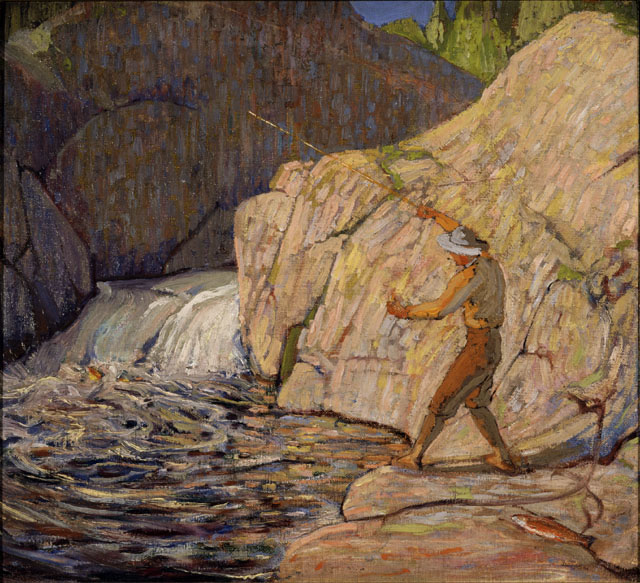
Image: Tom Thomson. c. 1916. The Fisherman. Oil on canvas. Collection: Art Gallery of Alberta.

All of the links for this post direct back to excerpts of transcribed historical documents provided on the website Death On A Painted Lake: The Tom Thomson Tragedy. Gregory Klages was Research Director for the site, launched by the Great Unsolved Mysteries in Canadian History project in 2008. Klages is the author of the 2016 book, The Many Deaths of Tom Thomson: Separating Fact from Fiction (Dundurn Press).